
Margaret (2011)

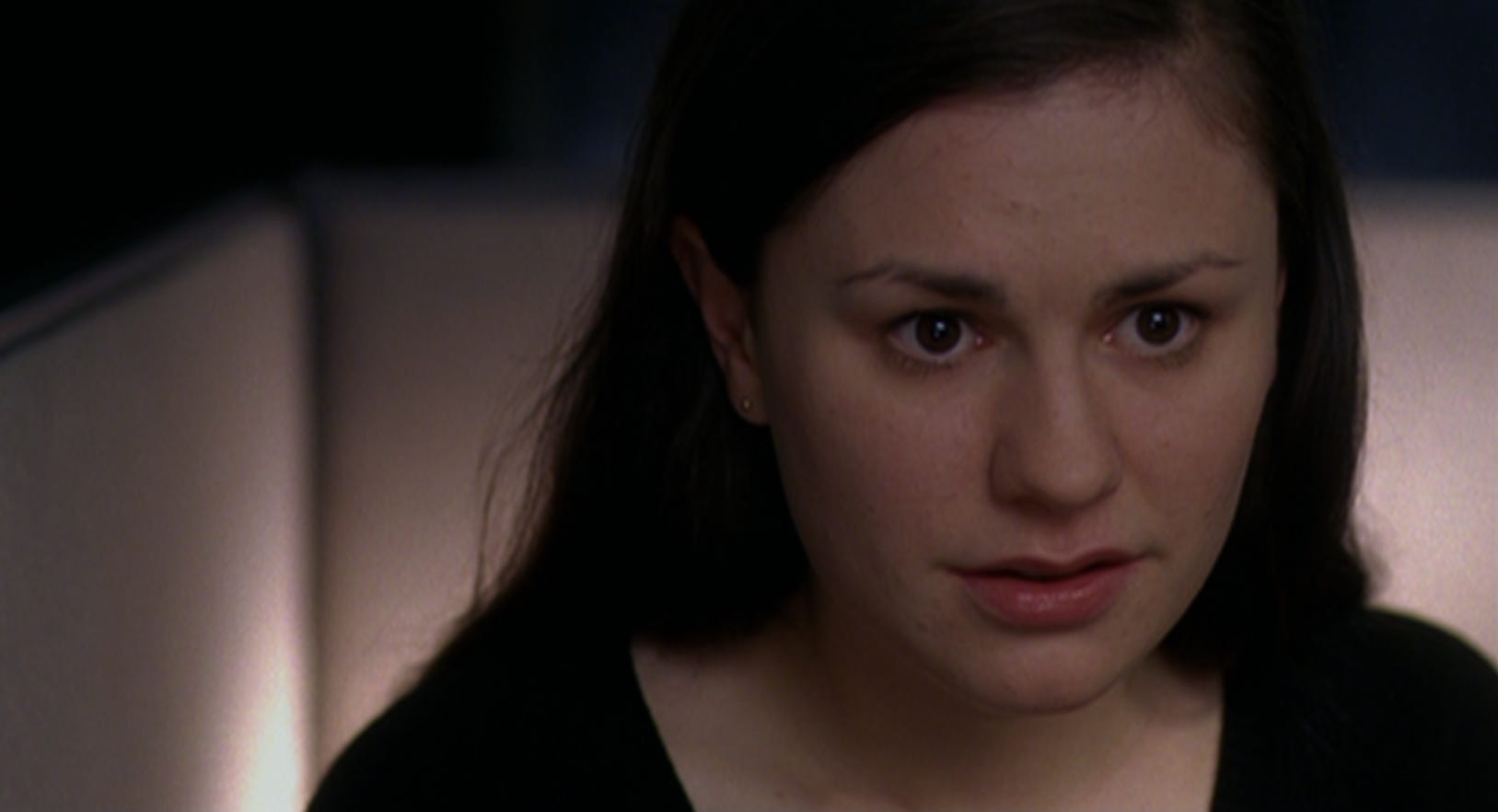
Margaret is like a film from a parallel Earth. It’s a 180-minute coming-of-age character study epic that sprawls and sprawls and sprawls, moving outwards from a traumatic accident to explore every prosaic detail of the lives that it touches. Writer/director Kenneth Lonergan departs from every established genre norm, observing the behaviour of several characters in small episodic chunks that form a grand tapestry of non-sequiturs and unresolved decisions. This is a warts-and-all view of upper-middle-class life in New York City circa 2005, with every tantrum, argument, stupid one-night-stand, offhand comment, failed relationship, cigarette, funeral and phoney epiphany included. Lonergan aims to create a work of art as messy, inconclusive, anticlimactic and frustrating as life itself. He succeeds.
Margaret’s script and camera focus on Lisa Cohen (Anna Paquin), a privileged and self-centred private school student who finds herself connected to a violent death. In a moment of irresponsible thoughtlessness, Lisa knocks on the door of a moving bus and waves at its driver to catch his attention. She likes his cowboy hat and wants to know where he bought it. Distracted by the pretty girl smiling and waving at him, the driver (Mark Ruffalo) runs a red light, hitting and killing a pedestrian (Alison Janney). Lisa holds the victim’s hand in her final minutes, returning home covered in blood and thoroughly shaken up. The accident perversely validates Lisa’s narcissism, placing her at the centre of a crucial moment and making her important to the police, the bus driver and the victim’s family. Lisa is a witness and an instigator: a person whose viewpoint, memory and actions matter. She enjoys her new role and embraces it.
Lisa doesn’t spend much time considering her own culpability or questioning her behaviour. Despite the fact that she distracted the driver, she doesn’t feel guilty, she doesn’t have sleepless nights and she doesn’t suffer from depression. Lisa bypasses introspection as an instinct: she’s always certain of everything that she does. When she argues with her mother, she knows she’s right. When she has an ill-advised one-night-stand with her preppy coke dealer, she knows she’s right. When she argues about the state of Israel in a school discussion group, she knows she’s right. When she wages a legal campaign against the bus driver, she sees herself as the physical embodiment of justice. Before the crash, Lisa used her unshakable confidence trivially. After the crash, she uses it to lash out against a world cruel enough to implicate her in a brutal death.
Lonergan creates a character as messy and self-aggrandising as we might expect an affluent Manhattanite teenager to be, leaving in every negative quality. Lisa is difficult and often unlikeable, subordinating everyone and everything to each of her passing whims. She isn’t a witty precocious Hollywood teen in the style of Diablo Cody’s Juno and she isn’t a lazy stereotype: she feels unsettlingly real. Her pattern of speech is so familiar and abrasive that I was taken aback at first, unused to hearing a genuine and unpolished teenage voice on screen. All of Lonergan’s character details are true: notice Lisa’s limited vocabulary, her victimisation complex and her uncanny ability to make every flippant change of mood sound deathly sincere. She tells three separate men that she loves them, changing her mind afterwards each time. She’s confused and far too sure of herself, stunned by violence and skilled at misplacing her feelings.
Lisa has a few teenage friends, but she lives in a world of knackered, jaded adults who lack the energy and perseverance to change the seventeen-year-old’s state of mind. Lisa’s mother, Joan (J. Smith-Cameron), is a stage actress who seems to have inspired some of her daughter’s theatricality. Joan loudly and forcefully shuts down the worst examples of Lisa’s selfishness, but acquiesces to casual rudeness. Like a lot of worn-out moms, Joan has decided to settle for intermittent resistance. Lisa’s dad (Lonergan in a cameo role) lives on the other side of the country, withering under his new wife’s domineering attitude and keeping everyone else at a distance. He may as well be a ghost. A sympathetic maths teacher, Mr Aaron (Matt Damon), tries to be the grounded voice of reason in Lisa’s life, meeting his student outside of school to discuss her troubles. He’s quickly defeated. Lisa seduces the teacher in a matter of minutes, leaving him to silently fear for his job and curse his poor judgment.
Every single detail in Lonergan’s New York, no matter how small, is given equal weight. While Lisa forcefully tries to make herself the centre of the Earth and the narrative, the director’s camera pulls away from her and makes a point of looking elsewhere, of observing other people. It took me a while to realise that the film’s form is a purposeful negation of Lisa’s egotism. Lonergan documents the ocean of life around Lisa: the path of an overhead plane, an argument between neighbours, office politics in a police station, snippets of overheard conversations and the hunched figure of Lisa’s jilted suitor crying alone in his bedroom. Dates between Jean and her new boyfriend Ramon (Jean Reno) are followed in great detail, including expansive information about his work history, knowledge of Italian verbs and taste for opera. It’s as though these scenes are there simply to confirm that life goes on when Lisa isn’t in the frame.
Stylistically, Margaret’s closest peers are the works of Edward Yang. Like Yang’s gargantuan Taiwanese domestic epics A Brighter Summer Day and Yi Yi, Margaret is an expansive movie that captures the mood of its place and time through a single family and its web of connections. Lonergan and Yang both use a violent incident as an anchor, following the reverberations outward across a cityscape and among different generations. Yang used his style to capture the politics and fears of mid-century Taiwan while Lonergan documents the unsettled atmosphere of a post 9-11 upper crust New York. Lengthy classroom debates reveal that casual islamophobia and hatred of George W. Bush are the liberal order of the day for a city living every moment in the aftermath of carnage.
New York dramas aren’t supposed to be like Margaret. They’re meant to be cosy two-hour Woody Allen/Wes Anderson affairs full of quirky pithiness, friendly music, elegant parties and family merriment. Lonergan’s film is radically different, so much so that it was barely released. After filming in 2005, it took six years and multiple lawsuits before Margaret made its way to very few theatres (fourteen in North America, one in the UK). Lonergan was insistent on creating a version of Margaret that ran to three hours, while his studio (Fox Searchlight) demanded a shorter cut. Martin Scorsese and Thelma Schoonmaker became involved in the editing process before a 150-minute cut was finally approved. Lonergan’s extended 180-minute cut is available on DVD, and it’s the version that I watched. The long length is justified. This is a film that exists to sprawl outwards, to embrace its tangents and digressions with purpose and feeling.
Anna Paquin is the film’s bedrock, making the Lisa character sympathetic and coherent even while she leans into every terrible trait. The safe, boring move would have been to try to ‘redeem’ the character with an understated performance of gazes and sighs, but Paquin bravely refuses to tone Lisa down, committing entirely to Lonergan’s vision of the character’s vanity and relentless energy. I think it’s the best realisation of a teenager that I’ve ever seen on screen. In a thousand small tics, incredulous looks and haughty exhales, Paquin creates a human being that I recognised and understood. Reality is the most difficult target of all, and Paquin hits the bullseye. Critic Scout Tafoya has said that if this film was released shortly after production wrapped, it would have changed Paquin’s entire career. He’s right.
If the lead is named Lisa, who is Margaret? Lonergan’s film takes its name from a figure in Gerard Manley Hopkins’ 1880 poem Spring and Fall. Margaret is a young child who is told by the poem’s narrator that her sadness at the changing of the seasons will soon become an existential fear of death. The poem ends: ‘It is the blight man was born for, It is Margaret you mourn for.’ The poem is discussed in Lisa’s English class but it doesn’t seem to have any impact on her. By the end of the film, like Margaret, Lisa will mourn for herself. Lonergan’s choice to make his film’s title reference this poem is significant because it signals Margaret’s intent: this film is a psychological spin on the staid coming-of-age story.
Margaret isn’t a film about the facts of turning 18. It isn’t about leaving home, getting drunk or having sex: it’s about the mental shift from the strange comfort of adolescence into the horror of adulthood. The bus crash may initially strengthen Lisa’s resolve, but it also punctures her childlike view of life. Death becomes both a possibility and an inevitability, conditioning every interaction and darkening every plan. The film’s final moments are bold and ambiguous, but it’s clear that they depict some kind of realisation. I think that Lisa hasn’t come to terms with what she’s seen until the film’s final seconds. She’s been holding back everything existential and unbearable, using the force of her personality and the distraction of her legal efforts as tools to ignore the obvious. Lisa makes the void of sadness wait, then it hits.